
Human studies of addiction have produced remarkable resources: genome-wide association studies of millions of people, polygenic risk scores, brain imaging cohorts, and postmortem brain banks. Yet translating those findings into mechanisms, and mechanisms into treatments, has been slow. One major reason: the animal studies meant to supply the mechanisms often failed to mirror the genetic and behavioral heterogeneity of the humans they were supposed to explain, one drug, one inbred strain, one biological level at a time.
PARC’s answer is not to run animal studies and human studies side by side and hope they meet. It is to build the comparison into the design of every project.
Speaking the same language across species
Three design choices make direct rodent-human comparison possible:
- A genetically diverse population. Heterogeneous stock (HS) rats capture the genetic complexity of human populations, and they come with deep pedigree information and existing genome-wide association infrastructure. That means genetics can be run the same way in both species: loci mapped in rats can be tested against loci mapped in human GWAS, rather than hoping a finding from a single inbred strain generalizes.
- A severity gradient that mirrors the clinic. The center’s cohorts are structured the way human studies are: from healthy controls through mild, moderate, and severe addiction-like behavior. That parallels how clinical cohorts, large studies such as ABCD, and human brain banks stratify people, so a rat cohort and a human cohort can be compared severity level by severity level.
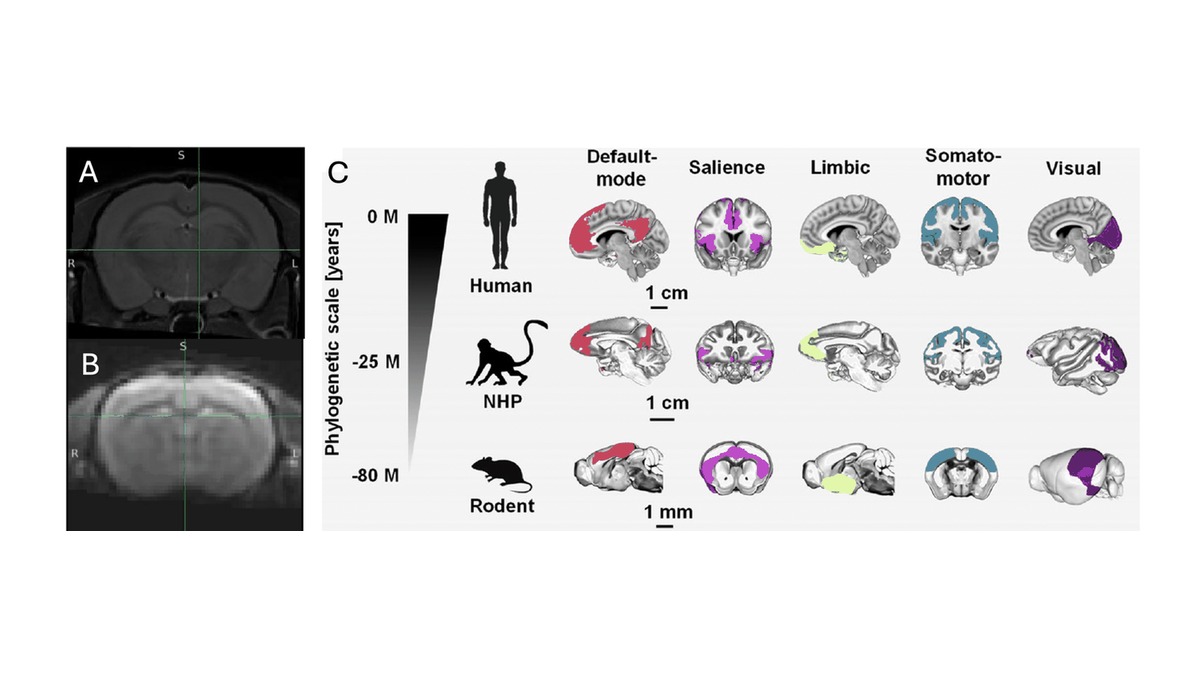
- Shared measurement modalities. Where possible, the center measures the same thing the same way in both species. The clearest example is functional MRI: the same imaging modality used in human addiction research is applied longitudinally to rats, so brain-network results can be compared directly rather than through analogy.
The comparisons, level by level
Each research project carries its own translational bridge:
- Genes and molecules. Project 1 aligns cell-type-specific transcriptional programs from rat nucleus accumbens with human single-cell datasets from postmortem brain tissue of individuals with alcohol and substance use disorders, including data generated through NIDA’s SCORCH program, and links rat-derived transcriptional modules to human GWAS and eQTL datasets.
- Brain networks. Project 2 uses graph theory to identify network hubs in rats, from single-cell whole-brain imaging and fMRI, and compares them directly with human fMRI datasets to map which addiction-associated network changes are conserved across species.
- The gut-brain axis. Project 3’s translational anchors include duodenal multi-omics from human cohorts with alcohol use disorder, a vagus nerve stimulation sub-study, and cultures of human iPSC-derived intestinal neurons that bridge rodent findings to human biology.
The Computational & Analytical Core ties these threads together with cross-species integration pipelines, common data standards, and machine-learning approaches applied to the combined data.
Translation runs in both directions
When a signature appears in both species, a transcriptional module, a network hub, a gut-immune marker, it becomes a high-priority candidate: a mechanism that can be manipulated causally in rats with direct relevance to patients. That is translation.
The reverse direction matters just as much. Human datasets anchor the preclinical work: human GWAS results tell the center which rat loci deserve attention, and human severity gradients define the behavioral benchmarks the models must meet. When a rat finding does not appear in human data, that is informative too, flagging mechanisms that may be species-specific before they consume years of drug development.
The bottom line
The historic weakness of preclinical addiction research was not the animals, it was the mismatch: homogeneous models asked to explain a heterogeneous disorder, measured in ways humans never are. By studying genetically diverse individuals, structuring cohorts the way clinical studies do, measuring with shared modalities, and aligning every data layer with a human counterpart, the center is designed so that discoveries are born translatable, and so preclinical results can improve their predictive value for the people who need treatments.
Learn more
- The One-Individual Multiscale Atlas, where the cross-species comparisons come together
- What animal models can and can’t tell us
- The genetics of addiction: what GWAS is teaching us