

Research project
Project 1: Brain Transcriptomics
Polydrug use, the concurrent or sequential use of multiple substances, is a growing public health concern and a leading driver of overdose deaths, particularly among people with opioid use disorder. Yet most of what we know about how drugs change the brain comes from single-substance studies: whether and how opioids interact with cocaine or alcohol to reshape neural circuits at the cellular level is essentially unknown.
“Dissecting Cell-Type-Specific Transcriptional Programs Across Substances of Abuse” addresses that gap in the nucleus accumbens (NAc), a key hub of the brain’s reward circuitry.
Approach
The project profiles the NAc with single-nucleus RNA sequencing (snRNA-seq) in heterogeneous stock rats with a history of intravenous self-administration of cocaine, oxycodone, oxycodone+cocaine, or alcohol, with tissue collected during prolonged abstinence, when persistent, clinically relevant molecular changes are present. Differential gene expression and gene regulatory network inference identify the transcriptional programs altered by each drug and drug combination, cell type by cell type.
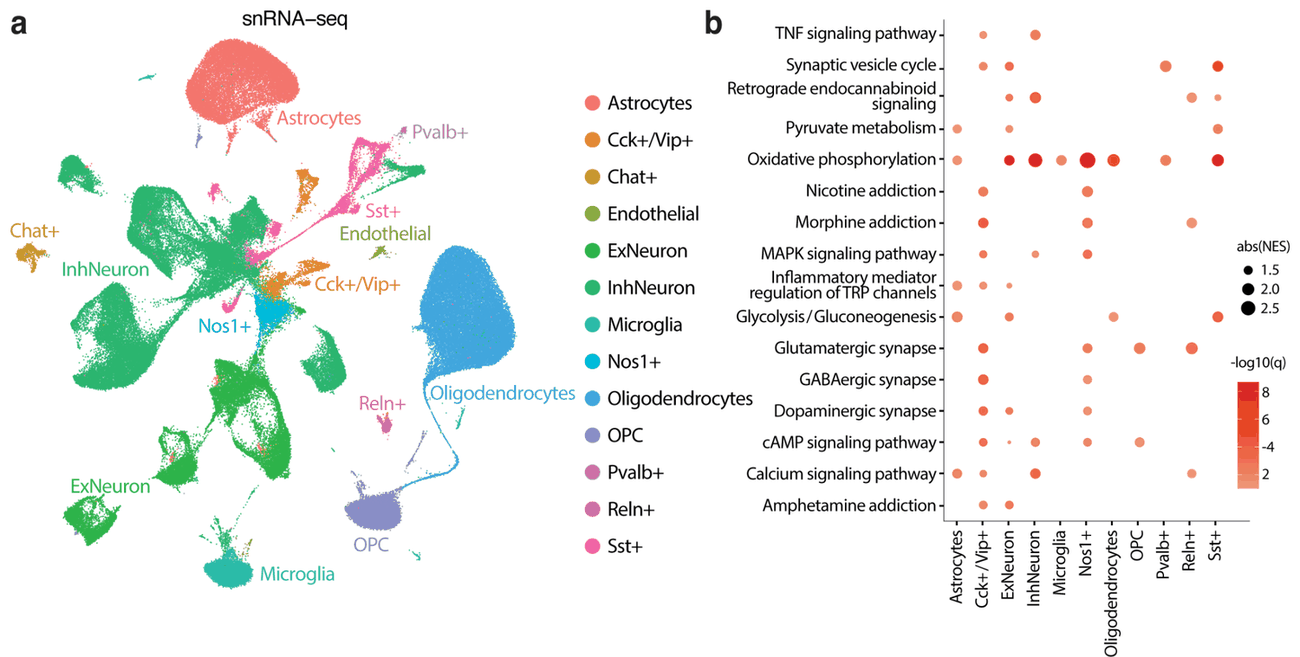 Preliminary data: snRNA-seq resolves the cell types of the nucleus accumbens (left) and reveals cell-type-specific enrichment of addiction-relevant pathways (right). (Figure from the Project 1 research strategy.)
Two features make the design unusually powerful. First, findings are benchmarked against single-cell datasets from human polydrug users generated through NIDA’s SCORCH program, so conserved and drug-specific signatures can be distinguished across species. Second, the project moves beyond correlation: top-ranked targets from Aim 1 are manipulated in rats undergoing oxycodone+cocaine self-administration, including pharmacological intervention with pBBG, a glyoxalase 1 (GLO1) inhibitor that reduced relapse-like behavior in the team’s prior studies, with snRNA-seq linking the molecular consequences of each manipulation to behavior.
Integration with the center
Tissues come from animals phenotyped by the Behavioral Phenotyping Core and banked by the Addiction Biobank Core; results are integrated with Project 2 (Brain Connectomics) and Project 3 (Gut–Vagus Multiomics) through the Computational & Analytical Core to build the One-Individual Multiscale Atlas.
Specific aims
- Use single-nucleus RNA sequencing to profile the nucleus accumbens of rats with a history of cocaine, oxycodone, oxycodone+cocaine, or alcohol self-administration during prolonged abstinence, and benchmark cell-type-specific transcriptional programs against single-cell datasets from human polydrug users (NIDA SCORCH program).
- Test the causal role of top-ranked candidate genes and pathways in polydrug addiction by manipulating them in rats undergoing oxycodone+cocaine self-administration, using pharmacological interventions including the glyoxalase 1 inhibitor pBBG, with snRNA-seq linking molecular consequences to behavioral outcomes.
Lead investigators
- Christine Cheng, PhD, Associate Professor, Psychiatry
- Francesca Telese, PhD, Associate Professor, Psychiatry