

Research project
Project 3: Gut–Vagus Multiomics
Alcohol, cocaine, and opioids each disrupt the intestine: microbiome dysbiosis, increased gut permeability, altered enteric nervous system function, impaired mucosal immunity, and vagus nerve dysfunction. Whether this gut damage merely accompanies addiction, or actively drives it, is one of the most important open questions in the field, and a potential source of entirely new therapeutics.
The scientific foundation
The project builds on a series of discoveries by the center’s investigators. Their recent Nature study showed that muscarinic acetylcholine receptor 4 (mAChR4) drives the formation of goblet cell-associated antigen passages (GAPs) in the gut, which educate immune cells to maintain mucosal immunity against bacterial translocation and prevent alcohol-associated liver disease. Alcohol downregulates mAChR4 and impairs this defense; restoring it, via gp130 (IL6ST) signaling or mAChR4 agonists, reinstates the protection.
The same receptor also matters in the brain: alcohol reduces mAChR4 expression in the dorsal striatum, mAChR4 agonists decrease ethanol- and cocaine-seeking in rodents, and mAChR4 deficiency increases substance intake. Transcriptomic analysis of duodenal samples from patients with alcohol use disorder shows parallel alterations in neuronal, immune, and epithelial markers. Together, these findings point to a gut–brain regulatory axis in substance use disorders whose vagal arm has never been systematically tested.
Central hypothesis: drug-induced disruption of gut homeostasis and vagus function exacerbates substance-seeking behavior, and preserving enteric–vagal signaling may protect against addiction.
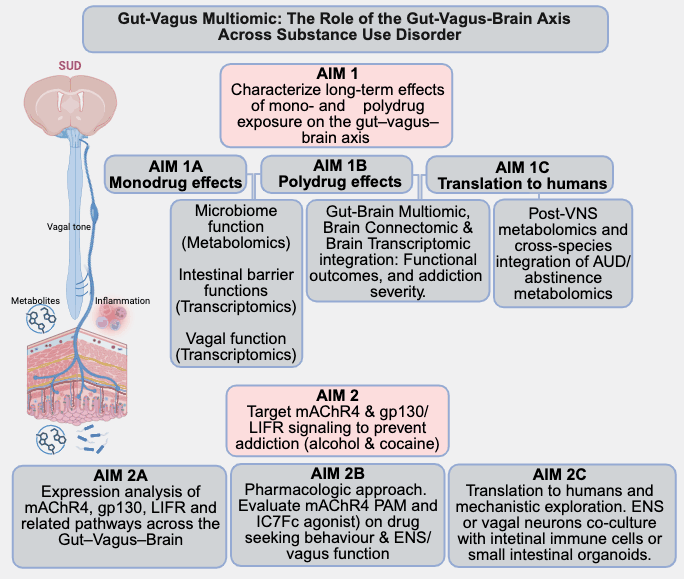 The project’s two aims span the full gut–vagus–brain axis, from microbiome and intestinal barrier to vagal signaling and drug-seeking behavior. (Figure from the Project 3 research strategy.)
Integration with the center
Gut, vagal, and brain tissues come from the same behaviorally phenotyped animals studied by Project 1 and Project 2, completing the body-to-brain dimension of the One-Individual Multiscale Atlas. Human translation includes cross-referencing rat datasets with patient samples and evaluating vagus nerve stimulation effects on gut metabolomics.
Specific aims
- Characterize the long-term effects of alcohol, cocaine, and oxycodone, alone and in polydrug models, on the gut–vagus–brain axis using integrated connectome, transcriptome (intestinal and vagal nodose neurons), and metabolome analyses; assess gut barrier integrity and vagus function; and translate findings by comparing rat and patient datasets, including the effects of vagus nerve stimulation on gut metabolomics.
- Examine modulation of mAChR4 and gp130 signaling to prevent cocaine and alcohol addiction, mapping their expression along the gut–vagus–brain axis and testing gp130 and mAChR4 agonists on drug-seeking behavior and neuroimmune function using in vivo models, organoid co-cultures, and pharmacological and genetic approaches.
Lead investigators
- Cristina Llorente, PhD, Assistant Professor, Medicine
- Bernd Schnabl, MD, Professor, Medicine