

Center core
Addiction Biobank Core
Animal models are essential for understanding addiction because they allow controlled drug exposure, dose, timing, environment, and causal manipulation of genes, cells, and circuits. But multi-omic studies too often rely on passive or limited-access exposure, thin behavioral characterization, and small cohorts, and biological samples are rarely shared, limiting replication and translational impact. The Addiction Biobank Core removes those barriers.
What the biobank holds
The core provides reproducible biological samples from heterogeneous stock (HS) rats with a history of extended-access self-administration of cocaine, oxycodone, alcohol, and polydrug (cocaine+oxycodone) use. Over the past six years, the team built separate biobanks for these drugs, enabling 75 collaborations and distributing ~4,000 samples from a repository of more than 40,000.
Specimens include whole brain and more than 20 dissected brain regions, blood, urine, feces, and peripheral organs, systematically collected at key timepoints: before drug exposure, intoxication, acute withdrawal, and protracted abstinence. Animals are whole-genome sequenced and scored on the Addiction Index, so every sample is linked to its donor’s genetics and behavioral phenotype.
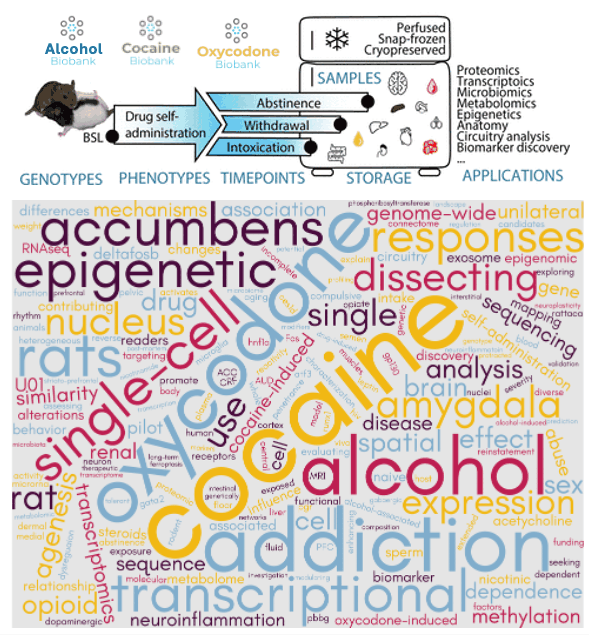 From behaviorally characterized animals to a national resource: sample types, timepoints, storage methods, applications, and the range of collaborative science the biobanks have already enabled. (Figure from the Addiction Biobank Core research strategy.)
What the P50 adds
- Unified repositories under standardized operating procedures, expanded with polysubstance self-administration cohorts and cohorts from the center’s research projects.
- The first national polydrug biobank, systematically incorporating stimulant–opioid co-use paradigms that model real-world polysubstance exposure.
- Aging cohorts followed into middle age (16–18 months) to support studies of drug-accelerated aging.
- The One-Individual Multiscale Atlas: tissues from the same animal used across all three research projects, enabling brain connectomic, brain transcriptomic, and gut–vagus multiomic analysis of the same individuals.
- A FAIR-compliant online portal linking barcoded specimens with behavioral, genetic, and multi-omic datasets, a dynamic, searchable platform for discovery.
Request samples

If you are interested, contact us or fill out a request form to initiate a collaboration:
Learn more in the founding publication: Carrette et al., eNeuro 2021.
Core leadership
- Olivier George, PhD, Professor, Psychiatry
- Giordano de Guglielmo, PharmD, PhD, Associate Professor, Psychiatry