About the center
About PARC
The Polysubstance Addiction Research Center (PARC) is a NIDA-funded P50 Center of Excellence at UC San Diego (award P50DA066459, 2026–2031).
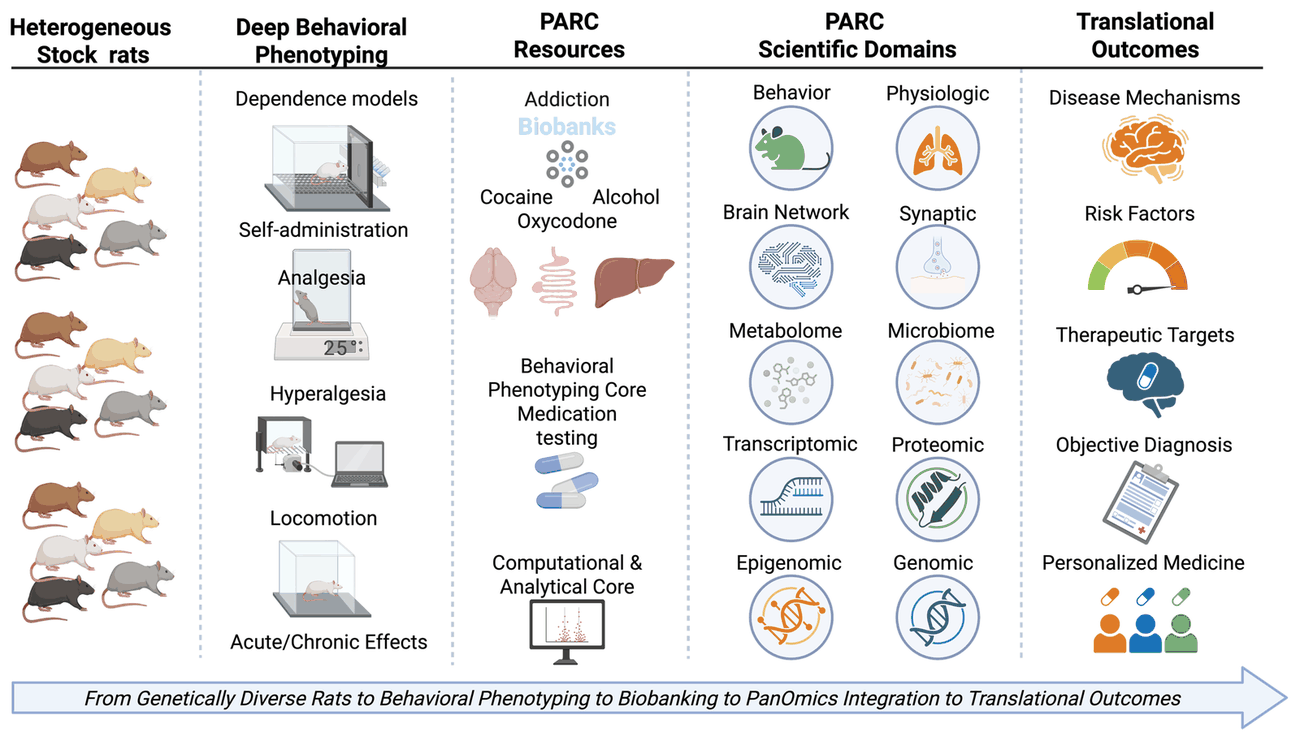
Most addiction research studies one substance at a time. Yet the biological question at the heart of the field cuts across substances: which mechanisms of addiction are shared by alcohol, opioid, and cocaine use disorders, and which are specific to each drug? PARC was created to answer that question. The center identifies convergent and divergent multiscale mechanisms of addiction-like behaviors across substances using genetically diverse heterogeneous stock (HS) rats, a population whose genetic variability mirrors that of humans.
Our history
PARC began in 2019, when the George Lab moved from The Scripps Research Institute to UC San Diego and, with colleagues, founded the Preclinical Addiction Research Consortium. Its founding idea remains the center's foundation today: apply multiscale approaches, from genes to cells to brain networks, grounded in advanced animal models of addiction-like behaviors. The behavioral model is the core of the center: understanding addiction begins with measuring it, one individual at a time. The consortium grew as former trainees rose to faculty and research positions at UC San Diego, including Drs. de Guglielmo, Kallupi, Carrette, and Schweitzer, creating a group of preclinical laboratories whose collaborations became a thriving ecosystem.
In six years, center investigators co-authored 29 collaborative publications together and secured 45 grants in state, federal, and private research funding. Along the way the consortium built the Addiction Biobanks, now roughly 40,000 specimens from nearly 4,000 behaviorally characterized rats supporting 75 external projects across the United States and Europe, tested more than 20 novel and repurposed therapeutic agents, and mentored nearly 400 students and postdoctoral fellows over the past decade. The NIDA P50 award consolidates, formalizes, and scales a proven model, and with it the consortium became the Polysubstance Addiction Research Center.
The One-Individual Multiscale Atlas
The center's defining resource is the One-Individual Multiscale Atlas: an integrated dataset in which brain connectomic, transcriptomic, and gut–vagus–brain measurements are collected from the same individual animals, each phenotyped on the same addiction-like behavioral measures. Because every data layer is anchored to the same individuals, the Atlas makes it possible to trace how genetic variation, gene expression, brain network organization, and body-to-brain signaling combine to determine an individual's vulnerability to compulsive drug use, across alcohol, opioids, and cocaine.
A national resource
Beyond its three research projects and scientific cores, PARC serves the wider research community through the Addiction Biobank, behaviorally and genetically characterized biological samples available to investigators worldwide, and a pilot funding program supporting new research directions and new investigators.
The UC San Diego environment
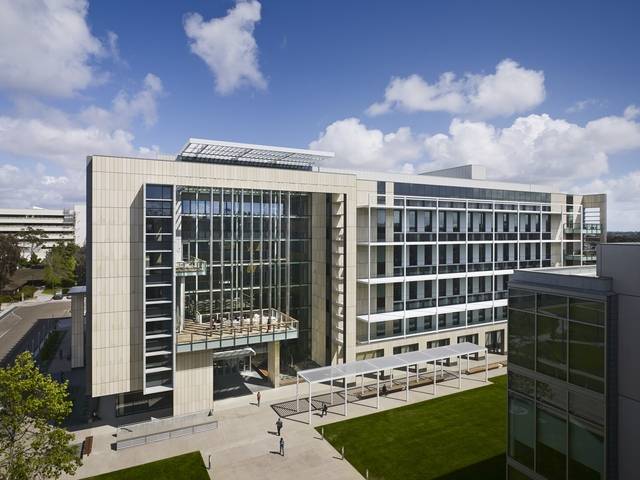
PARC is based in the Department of Psychiatry at the UC San Diego School of Medicine, with investigators across the Departments of Medicine, Obstetrics, Gynecology & Reproductive Sciences, Anesthesiology, and the Altman Clinical & Translational Research Institute. The center is strategically positioned to leverage the outstanding scientific environment of UC San Diego and the La Jolla research community.
Education & outreach
Public outreach and education are priorities for PARC investigators, who teach undergraduate and graduate students at UC San Diego and resident physicians and pharmacy students at UC San Diego and San Diego State University. The center provides internships to high school and college students, and PARC investigators participate in special events in public and charter schools, disseminating science through news media and collaborations with local organizations. See News & Events for examples.
Funding
Research reported on this website was supported by the National Institute on Drug Abuse of the National Institutes of Health under award number P50DA066459. The content is solely the responsibility of the authors and does not necessarily represent the official views of the National Institutes of Health or the University of California San Diego.
Contact
Department of Psychiatry, UC San Diego School of Medicine, 9500 Gilman Drive, La Jolla, CA 92093
Contact the center