

Research project
Project 2: Brain Connectomics
People differ markedly in their vulnerability to substance use disorders and in their response to treatment, but a critical gap remains: how does genetic variation shape behavioral variation through brain-wide mechanisms? Answering that question requires whole-brain endophenotypes: heritable, quantifiable traits that capture individual differences in brain organization. Such endophenotypes could enable early identification of high-risk individuals, biologically grounded subtyping, and precision-medicine interventions.
Approach
Project 2 generates brain-state maps of whole-brain connectivity in genetically diverse heterogeneous stock rats, the same animals characterized by the center’s behavioral pipeline and Addiction Biobank, using two complementary technologies:
- Longitudinal magnetic resonance imaging (MRI) tracks the same living animal before drug exposure, during escalation, and in abstinence. Because the measure is the same one used in human neuroimaging, results translate directly to clinical datasets, and longitudinal design distinguishes pre-existing, predictive differences from drug-induced adaptations.
- Multi-labeled, single-cell immediate-early-gene whole-brain imaging resolves the circuit mechanisms behind the MRI signal at cellular resolution.
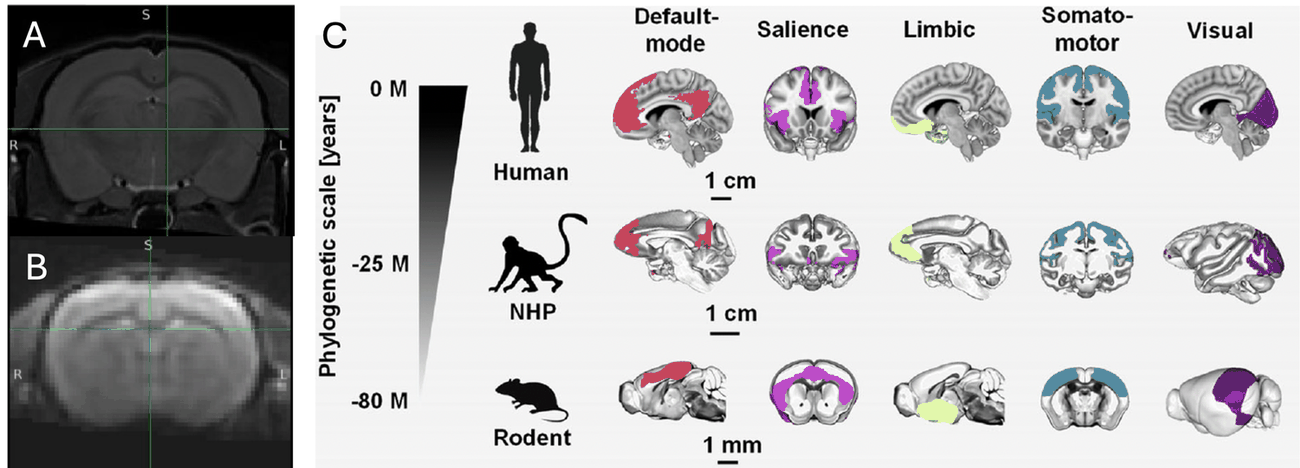 The brain networks measured in this project, default-mode, salience, limbic, somatomotor, visual, are conserved from rodent to human, making rat connectome findings directly translatable to clinical neuroimaging. (Figure from the Project 2 research strategy.)
The central hypothesis, supported by preliminary data, is that chronic substance use reduces functional network modularity during abstinence through cortico-subcortical disconnection, a biomarker also observed in humans with substance use disorders. The project further hypothesizes that altered prefrontal reactivity and insula-driven salience network engagement track addiction severity across substances, while subcortical adaptations are drug-specific and, in co-use, determine drug preference and treatment response.
This is the first large-scale, whole-brain imaging effort in genetically diverse populations exposed to single- and co-use drug paradigms, integrated with multi-omic datasets in a common framework.
Integration with the center
Imaging cohorts are phenotyped by the Behavioral Phenotyping Core and contribute tissue to the Addiction Biobank; transcriptomic and metabolomic profiling of the same animals (with Project 1 and Project 3) feeds the One-Individual Multiscale Atlas through the Computational & Analytical Core.
Specific aims
- Compare the long-term consequences of alcohol, stimulant, and opioid use, and their co-use, on connectome organization in abstinence, using longitudinal MRI and multi-labeled single-cell immediate-early-gene whole-brain imaging.
- Test whether pharmacological treatments of interest to the center normalize the identified connectomic alterations.
Lead investigators
- Lieselot Carrette, PhD, Assistant Professor, Psychiatry
- Benjamin McKenna, PhD, Associate Clinical Professor, Psychiatry