
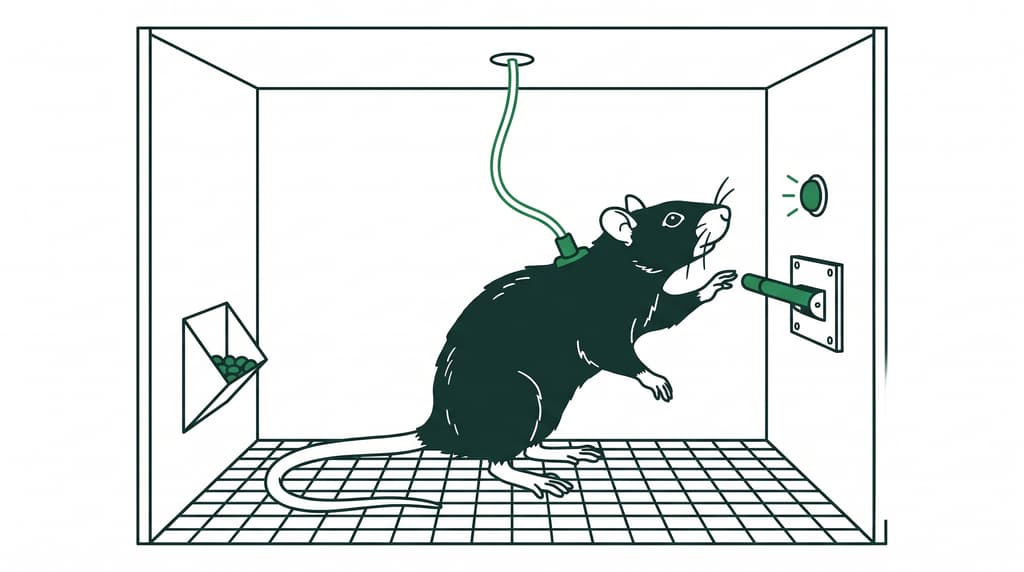
Almost every medication approved for a substance use disorder was tested in animals first. It’s not just a regulatory formality (in theory you can skip this step if there is evidence that the medication is safe), but in practive it reflects something remarkable: laboratory animals given the chance will voluntarily take the same drugs humans misuse, escalate their intake under similar conditions, and a vulnerable minority will progress to compulsive0like use that looks strikingly like the human disorder.
The core method: self-administration
In the foundational paradigm, a rat is fitted with an intravenous catheter and placed in a chamber where pressing a lever delivers a small dose of drug. The animal controls its own intake. If it presses repeatedly, the drug is reinforcing, and rats reliably self-administer cocaine, opioids, alcohol, and nicotine, the same substances that drive human addiction.
Researchers can then measure precisely what human studies can only approximate:
- How much an animal takes, session by session (intake)
- How hard it will work for the next dose, the “breakpoint” on a progressive-ratio schedule (motivation)
- Whether it persists when use has a cost, such as a mild footshock paired with the drug (compulsivity)
- What triggers relapse after abstinence: drug cues, stress, or a priming dose (reinstatement)
The key discovery: access changes everything
A pivotal finding came from comparing rats given short daily access to a drug (1–2 hours) with rats given long access (6+ hours). Most short-access animals keep stable, controlled intake indefinitely. Most long-access animals on the other hand escalate: taking more and more, working harder for it, and continuing despite punishment (Ahmed & Koob, 1998). Prolonged heavy exposure, in other words, produces the behavioral profile of addiction in the lab, mirroring the clinical observation that sustained heavy use raises the risk of losing control.
Just as important: even under long access, not every animal becomes compulsive. Using criteria modeled on the human diagnostic checklist, escalation, motivation, use despite consequences, researchers found that only a minority of rats meet all criteria, close to the 15–20% figure from human epidemiology (Deroche-Gamonet et al., 2004). Addiction vulnerability is an individual trait in rats, too, especially in genetically diverse rat populations built to mirror human variability.
What models can tell us
- Causal mechanisms. In animals, researchers can switch specific neurons on and off, measure gene expression in single cells, activate or remove a specific gene of interest, and image the whole brain, establishing cause, not just correlation.
- The biology of vulnerability. Because exposure is identical for every animal, differences in outcome reflect the individual’s biology, genes, circuits, physiology, cleanly separated from poverty, trauma, drug availability, and the other confounds of human life.
- Whether a treatment works before it reaches people. Candidate medications can be tested against escalation, motivation, and relapse-like behavior under rigorous, controlled conditions (Venniro et al., 2020).
What models can’t tell us
Honesty about limits is part of good science:
- No animal model captures the human experience of addiction: the social consequences, the stigma, the meaning. Models capture behavioral and biological processes, not lived experience, although efforts are underway to incorporate social aspects into addiction models.
- Some human factors don’t translate. Deep social context, peer influence, polydrug environments, and decades-long time courses are difficult to model fully.
- A win in rats is not a guaranteed win in patients, but it is guaranteed progress. Even when a candidate fails in clinical trials, what was learned about its mechanism, pharmacology, safety, and dose feeds directly into the design of the next medication. Historically, this approach has contributed significantly to every medication available for substance use disorders.
The bottom line
Animal models are not a substitute for human research, they are the causal engine that human research cannot ethically provide. Used carefully, with genetically diverse animals and clinically informed designs, they are the most powerful tool we have for turning the biology of addiction into treatments. For a deeper tour of the specific paradigms used at our center, see the behavioral models guide.
References
- Ahmed SH, Koob GF (1998). Transition from moderate to excessive drug intake: change in hedonic set point. Science 282:298–300. PMID 9765157
- Deroche-Gamonet V, Belin D, Piazza PV (2004). Evidence for addiction-like behavior in the rat. Science 305:1014–1017. PMID 15310906
- Venniro M, Banks ML, Heilig M, Epstein DH, Shaham Y (2020). Improving translation of animal models of addiction and relapse by reverse translation. Nature Reviews Neuroscience 21:625–643. PMID 33024318