
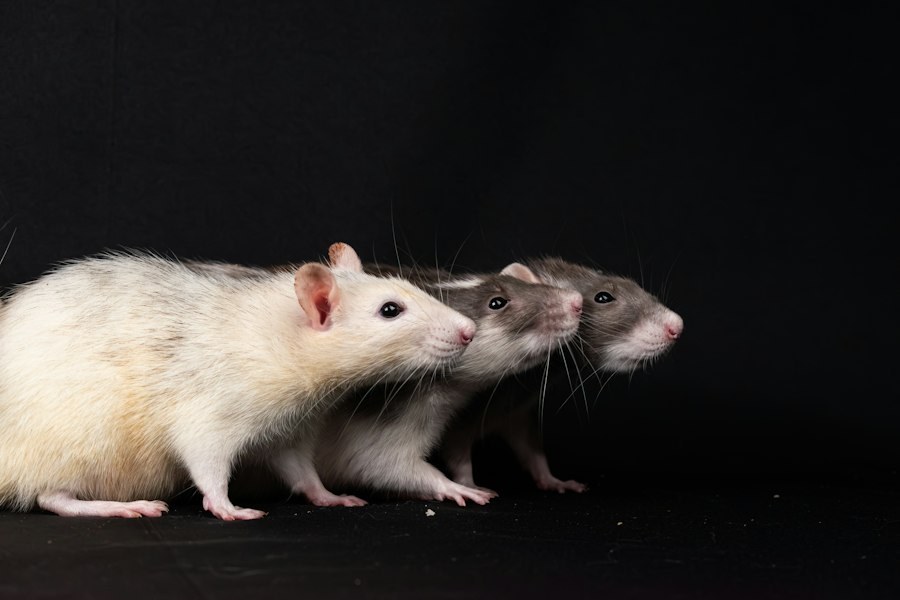
Most laboratory rodent research uses inbred strains, animals so genetically identical they are essentially clones. That uniformity is useful for many experiments, but it makes one kind of question impossible to answer: why do genetically different individuals respond differently to the same drug? For that, you need a population with genetic diversity, ideally, diversity that behaves like a human population’s.
That is exactly what heterogeneous stock (HS) rats provide.
What is a heterogeneous stock?
HS rats were created by interbreeding eight inbred founder strains and then maintaining the mixed population for decades, now approaching 100 generations of outbreeding (Solberg Woods & Palmer, 2019). Each animal carries a unique mosaic of chromosome segments inherited from the eight founders, the way each human carries a unique combination of variants from their ancestors.
The result is a laboratory population with three properties that make it ideal for genetic discovery:
- Every individual is genetically unique, so traits vary between animals just as they do between people.
- The genetic variation is well characterized: the founders’ genomes are fully sequenced, so every segment in every animal can be traced.
- Recombination over many generations has broken the genome into fine pieces, allowing genes to be mapped with high precision, much finer than in conventional crosses.
Why this matters for addiction research
Give a large cohort of HS rats identical extended access to cocaine, oxycodone, or alcohol, and their outcomes fan out along a continuum: most maintain controlled intake, while a minority escalates into compulsive, addiction-like use, mirroring the individual differences seen in humans (why only some become addicted).
Because every animal can be whole-genome sequenced and every animal’s behavior is measured on the same standardized pipeline, genome-wide association studies (GWAS), the same statistical approach used in human genetics, can identify the specific genetic loci that push individuals toward vulnerability or resilience. This approach has already mapped loci for physiological and behavioral traits in thousands of HS rats (Chitre et al., 2020), and more recently for cocaine addiction-like behavior itself (Lara et al., 2026).
From genetics to prediction: RATTACA
A genetic map is also a forecasting tool. The NIDA Center for GWAS in Outbred Rats (ratgenes.org) runs RATTACA, a program that uses genotype data to predict trait values in young HS rats, so investigators can request animals predicted to be, say, high or low in addiction-related traits before any behavioral testing. Prediction-based designs like this are a preview of what precision medicine could eventually look like in humans.
HS rats at PARC
Our center runs its alcohol, opioid, and cocaine studies in HS rats phenotyped on a common behavioral pipeline, with biological samples archived in the Addiction Biobank, each sample linked to the donor animal’s behavior and genome. The genetic diversity of the population is what makes the center’s central question answerable: which mechanisms of addiction are shared across substances, and which are specific (more on that question).
References
- Solberg Woods LC, Palmer AA (2019). Using heterogeneous stocks for fine-mapping genetically complex traits. Methods in Molecular Biology 2018:233–247. PMID 31228160
- Chitre AS et al. (2020). Genome-wide association study in 3,173 outbred rats identifies multiple loci for body weight, adiposity, and fatty acid levels. Obesity 28:1964–1973. PMID 32860487
- Lara MK, Carrette LLG et al. (2026). Genome-wide association study of cocaine self-administration behavior in Heterogeneous Stock rats. Nature Communications. PMID 42277005