
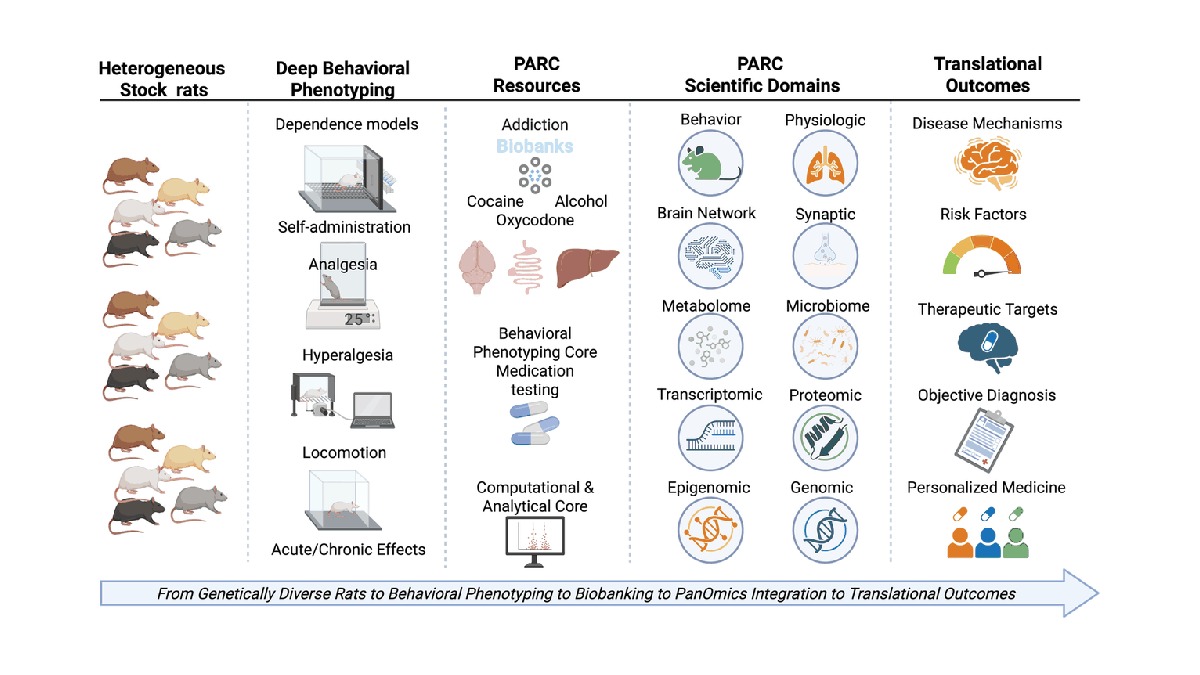
Modern biology has spectacular tools at every scale. We can sequence genomes, profile gene expression in single cells, map activity across whole brains, catalog gut microbiomes, and quantify behavior with precision. Each produces its own atlas of the brain or body.
But there is a structural problem: these measurements are almost always made in different individuals, in different studies, under different conditions. The transcriptomic atlas comes from one cohort, the imaging study from another, the microbiome survey from a third. Averaging across individuals erases exactly what addiction research most needs to see, the individual differences that separate vulnerability from resilience.
The idea: one individual, every scale
The One-Individual Multiscale Atlas is our center’s answer. The design principle is simple to state:
Measure behavior, genome, brain gene expression, brain network organization, and gut–vagus biology in the same individual animals: for alcohol, opioids, and cocaine, and integrate the layers at the level of the individual.
Concretely, one goal is to have some experiments where every heterogeneous stock rat in the center’s shared cohorts is:
- Behaviorally phenotyped on a standardized addiction pipeline (escalation, motivation, compulsivity) and scored on the Addiction Index;
- Whole-genome sequenced, anchoring every other measurement to genetic variation;
- Profiled transcriptomically, mapping cell-type-specific gene expression in addiction-relevant brain regions (Project 1);
- Mapped connectomically, from longitudinal imaging to brain-wide single-cell activity mapping (Project 2);
- Characterized along the gut–vagus–brain axis, including microbiome and intestinal biology (Project 3);
- Archived: tissues from the same animals enter the Addiction Biobank for the wider community.
Why within-individual integration changes the questions you can ask
When every layer comes from the same animal, correlation across scales becomes directly computable. That unlocks questions that cross-study comparisons can only gesture at:
- Chains of mechanism. Does a genetic variant → shift gene expression in a specific cell type → alter a brain network property → predict compulsive drug use? With all four measured per individual, the chain can be tested statistically, then verified causally.
- Convergence across substances. Are the individuals vulnerable to compulsive alcohol use biologically similar to those vulnerable to opioids or cocaine, at which scales do the substances converge, and at which do they diverge (the polysubstance question)?
- Cause versus consequence. Longitudinal measures collected before and after drug exposure separate pre-existing vulnerability markers from drug-induced change.
A resource, not just a study
Like the human genome project or brain-atlas consortia before it, the value of a multiscale atlas compounds when it is shared. The center’s data flow into public repositories (data sharing), the biological samples into the biobank, and the pilot program funds outside investigators to test their own hypotheses against the atlas.
The long-term vision is precision medicine for addiction (Volkow et al., 2016): understanding an individual’s risk and treatment response from their biology. Building the first individual-resolved, multiscale, cross-substance map of addiction is how that vision gets its foundation.
References
- Volkow ND, Koob GF, McLellan AT (2016). Neurobiologic advances from the brain disease model of addiction. New England Journal of Medicine 374:363–371. PMID 26816013
- Kimbrough A et al. (2020). Brain-wide functional architecture remodeling by alcohol dependence and abstinence. PNAS 117:2149–2159. PMID 31937658
- Carrette LLG et al. (2021). The Cocaine and Oxycodone Biobanks, two repositories from genetically diverse and behaviorally characterized rats for the study of addiction. eNeuro 8(3):ENEURO.0033-21.2021. PMID 33875455