
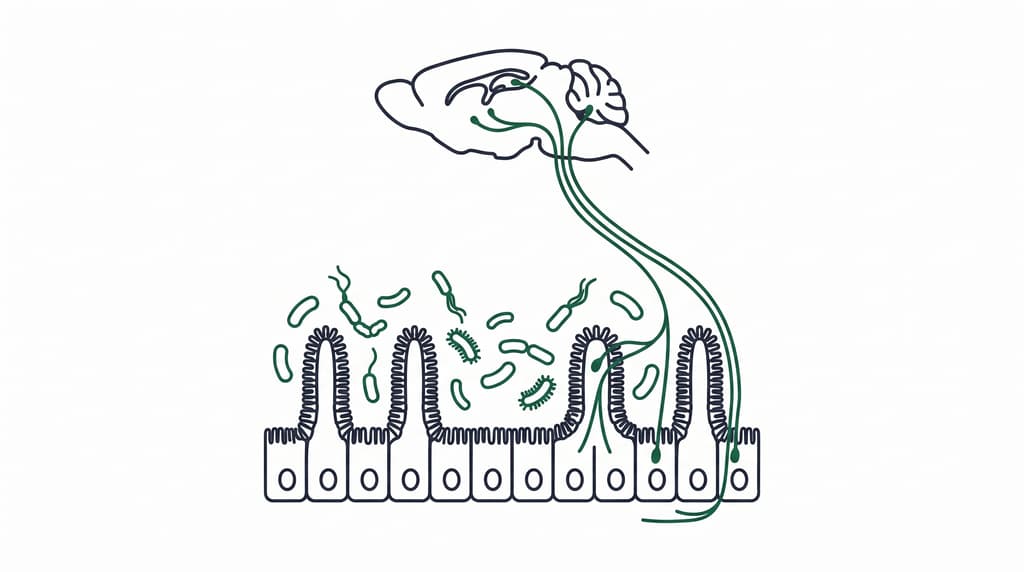
Your intestines house trillions of bacteria, a microbial organ, the gut microbiome, that digests food, trains your immune system, and manufactures hundreds of biologically active molecules. Over the past two decades, one of the most surprising discoveries in neuroscience is how much this microbial organ communicates with the brain, influencing stress reactivity, mood, and behavior (Cryan et al., 2019).
Addiction research is now asking a pointed question: does the gut help determine who becomes addicted, how severe withdrawal feels, and who relapses?
Three channels from gut to brain
The gut talks to the brain through at least three routes:
- The vagus nerve: a direct, high-bandwidth neural cable from the gut wall to the brainstem. Sensory neurons in the gut detect nutrients and microbial signals and relay them upward; remarkably, gut-to-brain vagal circuits can drive reward signaling in the brain’s dopamine system directly (Han et al., 2018).
- Immune signaling. When the intestinal barrier becomes leaky, bacterial products enter circulation and trigger inflammation, and inflammatory signals reach the brain, where they influence mood and stress circuits.
- Microbial metabolites. Gut bacteria produce short-chain fatty acids, neurotransmitter precursors, and modified bile acids that act on distant organs, including the brain.
The evidence in addiction
Alcohol provides the clearest case so far. Chronic alcohol use damages the intestinal barrier and reshapes the microbiome, and these gut changes track with the psychology of addiction. In a landmark human study, alcohol-dependent patients with high intestinal permeability (“leaky gut”) and dysbiosis showed more anxiety, more depression, and stronger alcohol craving after three weeks of detoxification than patients whose gut barrier was intact, a difference that predicts relapse risk (Leclercq et al., 2014). Work at UC San Diego has shown that gut bacteria also causally modulate alcohol’s damage to the liver, and that targeting specific gut bacteria can protect against it, proof that gut interventions can change alcohol-related disease.
Beyond alcohol, the gut–brain axis is increasingly implicated in stress regulation and reward processing broadly (Mayer et al., 2022), making it a plausible player in opioid and stimulant addiction as well. What has been missing is systematic, cross-substance evidence tying gut biology to addiction vulnerability at the level of the individual.
What PARC is doing about it
Our center’s Gut–Vagus Multiomics project profiles the microbiome, intestinal tissue, and vagal signaling in the same genetically diverse rats whose addiction-like behaviors toward alcohol, opioids, and cocaine are measured by our behavioral pipeline, and whose brains are mapped by our transcriptomic and connectomic projects.
Because all measurements come from the same individuals, we can ask directly: do animals vulnerable to compulsive drug use carry distinctive gut signatures? Do those signatures precede the addiction-like behavior or follow it? And do they converge across substances, or differ between alcohol, opioids, and cocaine? This body-to-brain dimension is what makes the center’s One-Individual Multiscale Atlas more than a brain atlas.
Why it matters
The gut is accessible in ways the brain is not. Diet, probiotics, bacteriophage therapy, and vagal stimulation are all plausible, testable interventions. If gut–brain signaling proves to causally shape addiction vulnerability or withdrawal severity, it would open an entirely new, and unusually practical, therapeutic front.
References
- Cryan JF et al. (2019). The microbiota–gut–brain axis. Physiological Reviews 99:1877–2013. PMID 31460832
- Han W et al. (2018). A neural circuit for gut-induced reward. Cell 175:665–678. PMID 30340046
- Leclercq S et al. (2014). Intestinal permeability, gut-bacterial dysbiosis, and behavioral markers of alcohol-dependence severity. PNAS 111:E4485–E4493. PMID 25288760
- Mayer EA, Nance K, Chen S (2022). The gut–brain axis. Annual Review of Medicine 73:439–453. PMID 34669431