
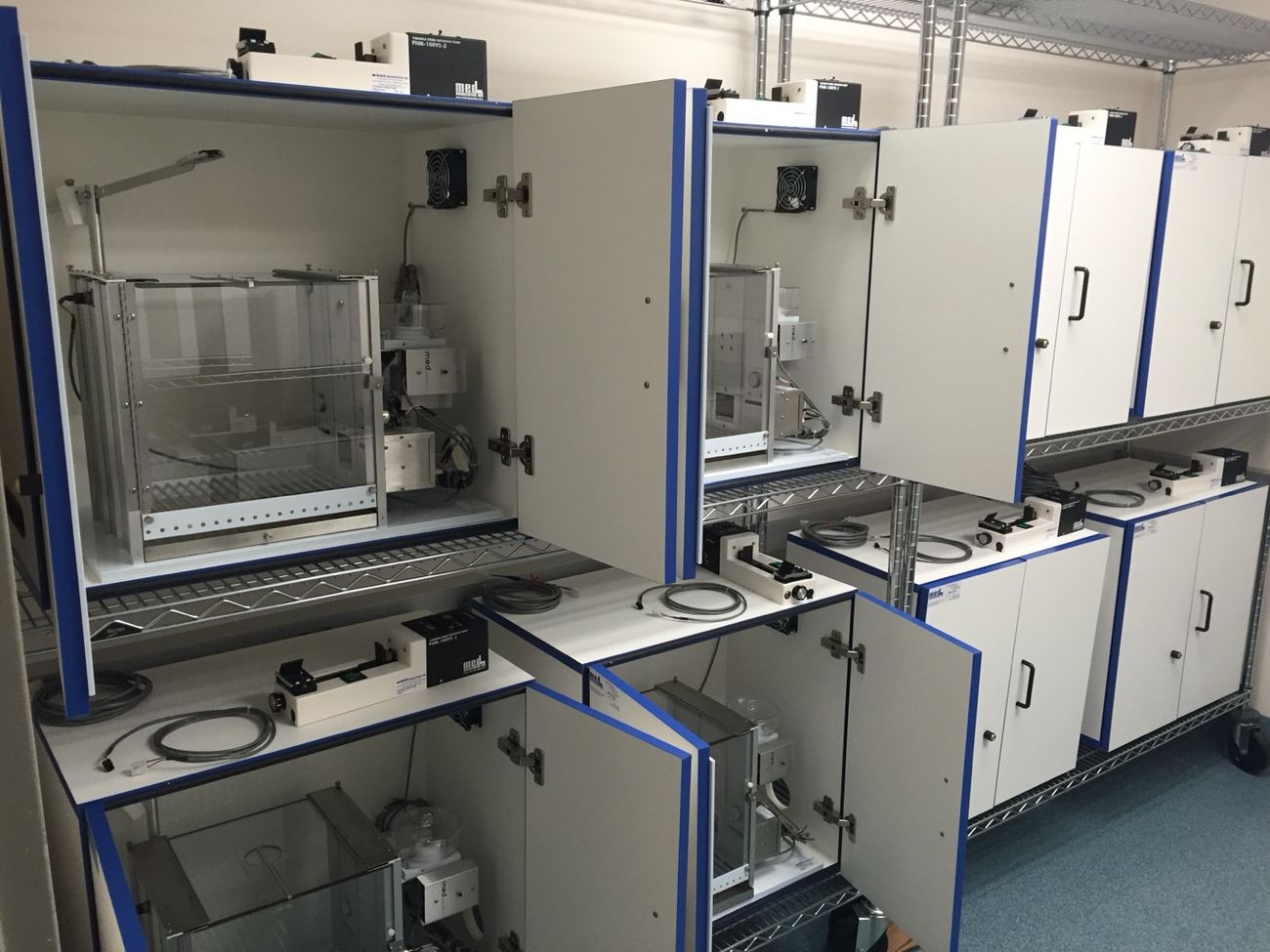
There is no blood test for addiction (yet). Clinicians diagnose a substance use disorder from behavior: loss of control over use, escalating consumption, continued use despite harm, craving. Those behaviors are formalized as the eleven diagnostic criteria for substance use disorder in the DSM-5, psychiatry’s diagnostic manual: meeting two or three criteria indicates a mild disorder, four or five indicates a moderate disorder, and six or more a severe one. If behavior defines the disorder in humans, then measuring addiction in animals means measuring the same behaviors, rigorously, quantitatively, and in every individual.
That is the logic of the Addiction Index.
Three criteria, borrowed from the clinic
Building on a landmark study that first demonstrated addiction-like behavior in rats using diagnostic-style criteria (Deroche-Gamonet et al., 2004), the index scores each animal on three dimensions that parallel the clinical picture:
- Escalation of intake. Given extended access to the drug, does the animal progressively increase its consumption beyond its own baseline, the laboratory signature of losing control (Ahmed & Koob, 1998)?
- Motivation. On a progressive-ratio schedule, where each successive dose costs more lever presses, how hard will the animal work before giving up? The “breakpoint” quantifies how much the drug is worth to that individual.
- Use despite negative consequences. If each dose is paired with a mild electric footshock, does the animal persist? Persistence under punishment is the operational definition of compulsive-like use.
Each animal receives a score on each criterion relative to its cohort, and the composite places it on a continuum from resilient to compulsive. In genetically diverse rat populations, roughly 15–20% of animals land at the compulsive end, the same fraction epidemiology finds among human drug users (why only some become addicted).
Why a continuum beats a cutoff
Addiction in humans is not binary, DSM-5 itself grades severity by symptom count. A continuous index preserves that reality in the laboratory and, critically, gives statistical power to genetic and biological analysis: a genome-wide association study can regress genotype against a graded phenotype, and every animal in the cohort informs the result, not just the extremes.
Beyond the three criteria
The index is the backbone of the phenotype, not the whole of it. The center also measures each animal on other addiction-relevant behaviors: sensitivity to the drug’s analgesic effects, the hyperalgesia that emerges with dependence, the development of tolerance, and incentive salience, the motivational pull that drug-paired cues acquire over time. The point of collecting multiple indicators in the same individuals is to go beyond a single severity score. Multidimensional behavioral profiles will make it possible to stratify individuals into biologically meaningful subtypes, to understand comorbidities such as chronic pain, and to match treatments to an individual’s profile rather than to a one-size-fits-all label, the foundation of precision medicine for addiction.
The index as connective tissue
The Addiction Index does its most important work as an anchor for everything else the center measures. Every sample in the Addiction Biobank is labeled with its individual’s Addiction Index score (Carrette et al., 2021). Every transcriptome, every brain-network map, every microbiome profile in the One-Individual Multiscale Atlas can be analyzed against the same behavioral yardstick, across alcohol, opioid, and cocaine cohorts.
One number never captures a disorder. But a standardized, clinically grounded, continuous measure of addiction-like behavior, applied identically to genetically diverse individuals, is what turns “addiction” from a label into a phenotype that genetics and neuroscience can actually dissect.
References
- Deroche-Gamonet V, Belin D, Piazza PV (2004). Evidence for addiction-like behavior in the rat. Science 305:1014–1017. PMID 15310906
- Ahmed SH, Koob GF (1998). Transition from moderate to excessive drug intake: change in hedonic set point. Science 282:298–300. PMID 9765157
- Carrette LLG et al. (2021). The Cocaine and Oxycodone Biobanks, two repositories from genetically diverse and behaviorally characterized rats for the study of addiction. eNeuro 8(3):ENEURO.0033-21.2021. PMID 33875455