
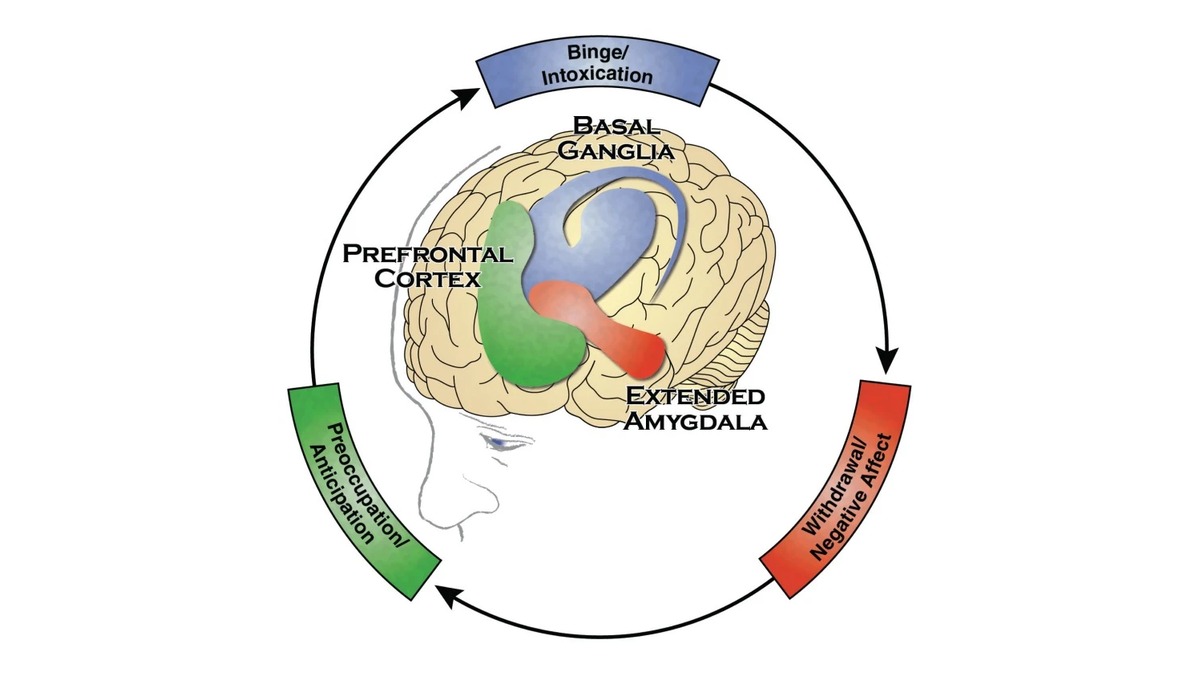
Ask a neuroscientist to explain addiction in one picture, and there is a good chance they will draw a circle with three arcs: binge/intoxication → withdrawal/negative affect → preoccupation/anticipation (craving) → back to binge. This three-stage cycle, developed by George Koob and Michel Le Moal in the late 1990s, remains the most influential framework in addiction neuroscience (Koob & Le Moal, 1997; Koob & Volkow, 2010).
The framework’s power is that each stage maps onto a distinct brain system, which means each stage can be studied, modeled, and targeted for treatment separately.
Stage 1: Binge/intoxication, the basal ganglia
In the early stage, drug taking is driven by reward. Drugs of abuse produce surges of dopamine signaling in the basal ganglia, the brain’s action-selection and habit machinery. With repetition, cues associated with the drug, people, places, paraphernalia, acquire “incentive salience”: they grab attention and trigger wanting, independent of how much pleasure the drug still gives. Habit circuits gradually take over what began as a deliberate choice.
Stage 2: Withdrawal/negative affect, the extended amygdala
The defining transition of addiction happens here. With prolonged heavy use, the brain adapts: reward circuitry becomes blunted, and stress systems in the extended amygdala, including corticotropin-releasing factor (CRF) signaling, become hyperactive. When the drug wears off, the result is not just physical discomfort but a genuinely negative emotional state: anxiety, irritability, dysphoria, an elevated “reward threshold” where ordinary pleasures no longer register (Koob & Le Moal, 1997).
At this point the motivation flips. The person (or animal) is no longer using to feel good, they are using to escape feeling bad. This shift from positive to negative reinforcement is widely considered the neurobiological signature of addiction. Work at UC San Diego identified specific neuronal ensembles in the central amygdala that are required for this state in alcohol dependence (de Guglielmo et al., 2016).
Stage 3: Preoccupation/anticipation, the prefrontal cortex
Between episodes of use, the addicted brain is not at rest. Craving, triggered by drug cues, stress, or a small “taste” of the drug, reflects activity in prefrontal and insular circuits, while the prefrontal systems that normally impose restraint are impaired. The other critical element of this stage is incentive salience: through repeated pairing with the drug, the people, places, and paraphernalia surrounding use acquire a motivational pull of their own, so that a cue alone can ignite drug seeking. Together, impaired restraint and cue-driven salience explain one of addiction’s cruelest features: relapse after months or years of abstinence, often set off by a single stressor or reminder.
Why a cycle, not a line?
Because each pass through the cycle deepens the adaptations. Escalating intake worsens withdrawal; worse withdrawal strengthens negative reinforcement; craving restarts the binge. Laboratory models capture this progression directly: animals given extended access to drugs escalate their intake and show elevated reward thresholds, increased motivation, and stronger relapse-like behavior, the full behavioral profile of the cycle (Ahmed & Koob, 1998).
How PARC uses the framework
The three-stage cycle is the scaffold for our center’s behavioral phenotyping. Each stage has validated animal-model measures: self-administration and escalation for binge/intoxication; anxiety-like behavior, irritability, and reward thresholds for withdrawal/negative affect; and cue-, stress-, and drug-induced reinstatement for craving (see our behavioral models guide). By scoring every individual animal across stages, and across alcohol, opioids, and cocaine, we can ask where in the cycle vulnerability arises, and whether it arises at the same place for every substance.
References
- Koob GF, Le Moal M (1997). Drug abuse: hedonic homeostatic dysregulation. Science 278:52–58. PMID 9311926
- Koob GF, Volkow ND (2010). Neurocircuitry of addiction. Neuropsychopharmacology 35:217–238. PMID 19710631
- de Guglielmo G et al. (2016). Recruitment of a neuronal ensemble in the central nucleus of the amygdala is required for alcohol dependence. Journal of Neuroscience 36:9446–9453. PMID 27605618
- Ahmed SH, Koob GF (1998). Transition from moderate to excessive drug intake: change in hedonic set point. Science 282:298–300. PMID 9765157